October 22, 2026
Toukir Islam: Florida Class G License — The Complete Armed Security Guide (2027)
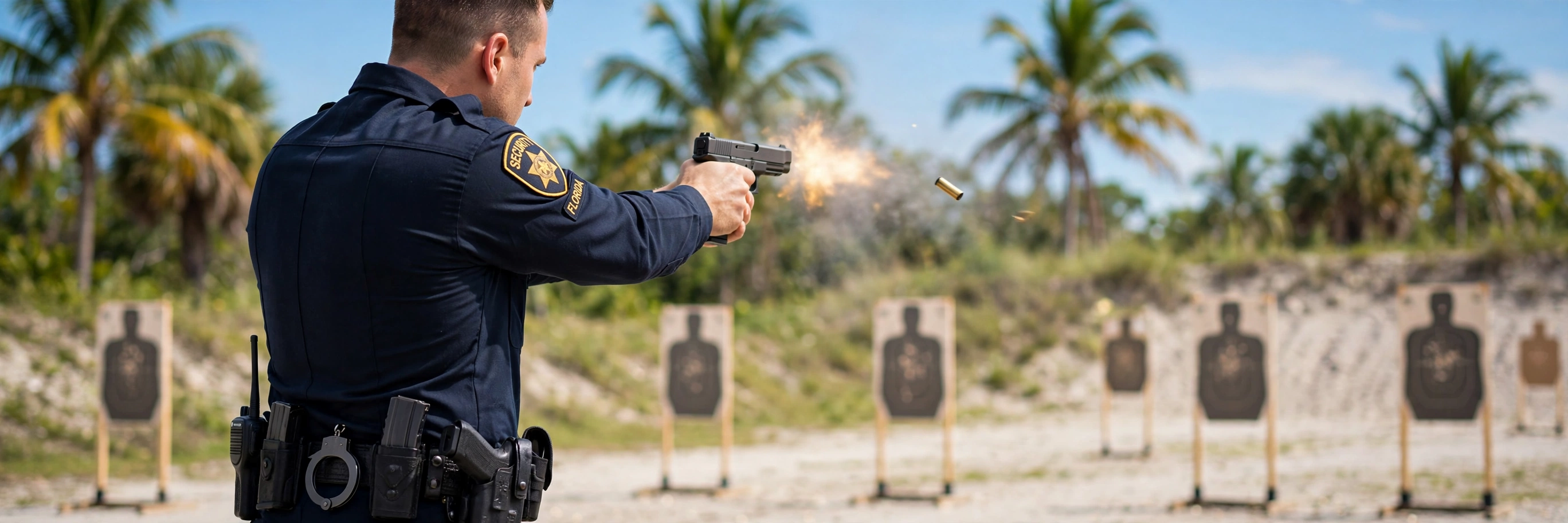
Every unarmed officer in Florida eventually hits the same ceiling: the posts pay $15 to $18 an hour, and the only way up looks like seniority. The Class G license is the door most officers walk past. It is Florida's statewide firearm license for armed security work — and I hold it. Most guides give you a comparison table and stop. This is the full picture: the training hour by hour, the real costs, how the qualification works, and the one rule that quietly gets officers suspended every year.
What the Class G License Actually Is
The official name is the Class "G" Statewide Firearm License, issued by the Florida Department of Agriculture and Consumer Services (FDACS). The most misunderstood fact: it is an add-on, not a standalone license. Florida law says only holders of a Class C, CC, D, M, MA, or MB license may bear a firearm while performing regulated duties — and every one of them must also hold a Class G. For an officer, your Class D stays active alongside your Class G; a Class D alone on an armed post means you are carrying illegally. And your personal concealed carry permit does not cover you on duty — the G is the only license that authorizes a firearm in the performance of security work.
Do You Qualify?
You must be at least 18 and a U.S. citizen or permanent legal resident alien, with documentation to prove it — birth certificate, U.S. passport, driver's license, Social Security card, or permanent resident card. You must hold (or be applying for) the underlying license, which for officers is the Class D — many schools sell the D and G as a bundle so you can apply for both together. Then the background check: electronic fingerprints go to the Florida Department of Law Enforcement and the FBI, and FDACS reviews your history for good moral character. Starting from zero? My step-by-step licensing guide covers the Class D side first.
The 28-Hour Course, Hour by Hour
Every guide says "28 hours of firearms training" and stops. FDACS publishes the actual split. Twelve hours are legal aspects: Chapters 493, 775, 776, and 790 of the Florida Statutes, plus civil and criminal liability for using a firearm. Nearly half the course is law — an armed officer who doesn't understand use of force is a liability. Eight to eleven hours cover firearms safety and mechanics, ending with a written exam. Eight hours are qualification: stance, grip, sighting, range safety and commands. Range time is capped at eight of the twenty-eight hours, and the qualification itself is 144 rounds: 48 practice rounds plus two full 48-round qualification cycles. The course must be taught by a state-licensed Class K firearms instructor, and the range work is always in person — some schools run the classroom portion live online, but nobody does the range online. Current or recently certified law enforcement and corrections officers, and federal law enforcement officers with agency firearms training, can have the training waived.
The Range Qualification
The qualification is a 48-round course of fire, shot with the exact type and caliber you intend to carry — your proficiency certificate is tied to that specific gun. Licensed schools run a passing standard of 168 out of 240 points (70 percent). My honest advice: don't make the course your first time shooting. Range day is where you prove your shooting, not where you learn it — get to a public range beforehand and get comfortable with drawing, reloading, and clearing malfunctions. On the annual requalification you get up to three attempts at the 48-round cycle; fail all three and the instructor sends you for remedial training to try another day.
Which Handguns You Can Carry
Florida law is specific, and thin guides always skip this. A Class G licensee may carry: a .38 caliber revolver; a .380 or 9mm semiautomatic pistol; a .357 revolver loaded with .38 ammunition only; a .40 caliber handgun; or a .45 ACP handgun — plus any other firearm the department approves. Two more rules from the statute: no more than two firearms, and only the specific type and caliber you qualified with. Buy a different gun after your course and you cannot carry it on duty until you qualify with it — which is also why the annual requalification applies to each type and caliber you carry.
The Application and the Real Cost
The package goes to the FDACS Division of Licensing — regional office or mail — with your certificate of firearms proficiency, citizenship documentation, a color photo, your fingerprint submission, and the fees. From the FDACS fee schedule: $112 license fee, $42 fingerprint processing, $10.75 fingerprint retention — $164.75 total for the initial license (one fingerprint fee covers you if you applied for another Chapter 493 license in the last six months). Renewal license fee is $127, with fingerprint fees again at renewal. Not included: the course itself — schools around South Florida typically charge $200 to $300 plus ammunition, so budget roughly $400 to $500 all-in. The license is valid for two years.
The Psych Evaluation — the Rule Everyone Gets Wrong
School sites say a psych eval is "sometimes required." Here is what the statute actually says: when a security agency requests a temporary Class G license — so a new hire can work armed while the full background check runs — the agency must certify the applicant was found mentally and emotionally stable within the previous twelve months via a validated written psychological test, an evaluation by a licensed psychiatrist or psychologist, or a recent DD Form 214 showing no instability at discharge. The screening is real, but it is tied to the employer-driven temporary-license process — not a form you mail to FDACS with the standard application.
The 4-Hour Annual Requalification
This is the rule that quietly suspends officers every year. The license term is two years, but the training obligation is annual: four hours of requalification every year with a licensed Class K instructor — curriculum review, recent law changes, and the 48-round qualification cycle — for each type and caliber you carry. Miss the annual training in the first year of your term and your Class G is automatically suspended until you fix it. Mark the anniversary in your phone the day your license arrives and book a month early; schools across Florida run the 4-hour course monthly.
Is It Worth It?
In my experience, yes — it is the highest-return credential a Florida officer can get. Armed posts consistently pay several dollars an hour more than unarmed ones; schools and salary guides typically report armed ranges in the $20s per hour, with experienced armed officers and specialist roles going higher. I break down how officers push past $30 an hour in this playbook. Roughly $400 to $500 once, and a permanent pay bump on every armed shift. Stack it with the TWIC card for port and maritime posts, and you leave the crowded unarmed job pool behind. The Class G doesn't just let you carry a firearm — it moves you into a smaller, better-paid group of officers.
Frequently Asked Questions
Do I need a Class D license before I can get a Florida Class G license?
Yes. The Class G is an add-on, not a standalone license — only holders of licenses like the Class D may bear a firearm on duty, and they must also hold a Class G. Many schools bundle both courses so you can apply at the same time. Carrying on a security post with only a Class D is illegal under Chapter 493.
How much does the Florida Class G license cost?
State fees total $164.75 initially: a $112 license fee, $42 fingerprint processing, and $10.75 fingerprint retention. The 28-hour course typically costs $200 to $300 plus ammunition. The renewal license fee is $127, with fingerprint fees again at renewal.
What score do I need to pass the Class G range qualification?
The qualification is a 48-round course of fire with the exact type and caliber you will carry. Licensed Class K schools run a passing standard of 168 out of 240 points. On the annual requalification you get up to three attempts; fail all three and you must do remedial training and try again later.
Do Class G holders have to requalify every year?
Yes. Florida law requires 4 hours of requalification every year with a licensed Class K instructor, for each type and caliber you carry — even though the license term is two years. Miss the annual training in the first year of your term and your Class G is automatically suspended.